Saturday, March 15, 2008

sid bream

bream
Sid Bream from Baseball Almanac


Braves announcer Skip Caray: Swung, line drive left field! One run is in! Here comes Bream! Here's the throw to the plate! He is...safe! Braves win! Braves win! Braves win! Braves win!...Braves win!

Sidney Eugene "Sid" Bream was born August 3, 1960 in Carlisle, Pennsylvania. And he's generally recognized as the player that broke Pirate's fans hearts the most with his game winning slide in the 1992 NLCS (although Pittsburgh rooters dispute the call to this day.) An odd choice for a torch bearer for the Bucs, no?

Well, not really. Bream played for 4 teams in his career (LA Dodgers, the Pirates, Atlanta Braves, and Houston Astros), batting .264 with 90 HRs and 455 RBIs in 12 NL seasons. He was known as a slick fielding first baseman and perhaps the slowest human to ever don a major league uniform. His knees were alleged to be as arthritic as a decrepit granny's.

His best years were with the Pirates, where he started at first and he had career highs in hits, RBIs and HRs.

After attending Liberty University, Bream was drafted in the second round by the Los Angeles Dodgers in the 1981 amateur draft. He tore up the minors, hitting .329 with 83 home runs and 407 RBI, including a .419 on-base percentage and a .537 slugging percentage in the Dodgers farm system.

He made his LA debut in 1983, but proved to be just an average MLB hitter. The Dodgers finally gave up on Bream late in the 1985 season and traded him and Cecil Espy to the Pirates for Bill Madlock, who was on the backside of his career.

It was in Pittsburgh where Bream finally got a chance to play every day. In 1986 he set an MLB record with 166 assists at first base. He usually batted in the six spot, averaging 12-15 HRs and 65-70 RBIs. Bream won the Fred Hutchinson Award in 1990 after coming back from a serious knee injury.

He became a platoon player after the injury, sharing time with Gary Redus. Bream went 4 for 8 with 2 walks and 3 RBIs in the 1990 NLCS, but Pittsburgh lost to the Reds *sigh*. Overall, he hit .269 with 57 HRs, 293 RBIs and 243 runs scored in his five seasons with the Bucs.

He then became a free agent and signed with the Atlanta Braves, as the Bucs were committed to Orlando Merced as their first baseman of the future.

Bream suffered through more injuries in Atlanta, limiting his playing time. But he did participate in two World Series, in 1991 and 1992. In the two years that he faced his former teammates in the NLCS, both won by the Braves in 7 games, he hit .281 with 2 HRs, 4 2Bs, 5 RBIs and 6 runs scored. That last one was a killer.

After a poor start in 1993, he became a pinch-hitter for the rest of the season, a role in which he thrived. Fred McGriff made him expendable, and Bream signed with the 'Stros as a backup to Jeff Bagwell in 1994. He hit .344 in 60+ at bats, and retired the next season during the baseball strike.

Bream was just hired by the Bucs as the hitting coach for the State College Spikes of the New York-Penn League for rookies.

And he brings a lot to the table beyond "the slide." Bream was a player that persevered in the majors. He wasn't the most athletic and God knows not the fastest player, but he accepted whatever role he was put in and succeeded at it, whether it was starting, platooning, being a backup or a pinch hitter. He fielded better than men with twice the natural physical talent.

Bream was a winner during his career, playing in four NLCS and two World Series. He knows what it takes to bring home a victory and how to play under the national limelight.

One Atlanta magazine picked him as the 24th best Brave of all time. And not just because of getting the call against Spanky, but because of what he brought to the team.

Bream was a clutch hitter, one of the better fielding first basemen in the game, and a good head in the clubhouse. A dedicated Christian, the word used to describe him in the article was "serene." And he could rake in the minors. He can share with the kids the mental aspects of baseball as well as the physical mechanics.

If Bream can bring those qualities to the youngsters he'll be teaching in State College, the Pirates will have a solid foundation to build on for the future.

(Our contribution to spring training will be highlighting the careers of the old Bucs in camp who are trying to pass on the torch to today's squad. Up next - Carlos Garcia)

Friday, March 14, 2008

crystal blue persuasion

billy crystal
Yankee DH Billy Crystal from MLB
Photo by Kathy Willens of Associated Press


OK, we admit we were honked when the Yankees sprung the one-day minor league signing of 59 year old comedian Billy Crystal on the world. Of course he would get his day in the sun against the Pirates. They wouldn't dare bat him lead off against, oh, lets say the BoSox. Schilling might drill him.

But the more we thought about, the easier it was to come to grips with it. The Evil Empire did clear it with the Bucs first before announcing it. To a man, from management to the roster, they all seemed to have no problem with it. And if it was OK with Paul Maholm, it's OK with us.

After all, baseball is supposed to be a game, and it is the dog days of spring training when interest kinda lags among the fans. So lets have a little fun and stir up some good PR for a change. How often do the Pirates make the top fold of the NY sport pages?

Maholm did his part, striking out Crystal. And he had enough class to throw him nothing but heaters with something off them, no breaking stuff to embarrass him. Crystal did his part by softly hooking a foul down the first base line and working Maholm for a full count before whiffing.

And he did at least go down swingin', on ball four, if reports are accurate. (The word is out that Crystal has poor plate discipline, hehe.) Had he taken the pitch, Maholm had already decided what would be next, according to MLB.com. He told them "If I walked him, I was trying to pick him off." Playtime only lasts so long.

The Yanks were smart enough to bat him leadoff and kept him in the dugout and off the field so the circus could end quickly and the business of baseball could begin.

Maholm and Crystal exchanged autographed balls after the game and had nice things to say about one another to the merry media mob (several publications called him the "Yankee Quipper," with good reason.)

A win-win situation, especially when the Bucs end up with the victory after being no-hit by Mike Mussina for five but hanging in there long enough to take Jeff Karstens to school. Maholm traded zeroes with Moose, so obviously he wasn't too distracted.

Now if we can sign Michael Keaton next year, just before we play the Yankees...

Thursday, March 13, 2008

rich donnelly

rich donnelly
Rich Donnelly from MLB
Photo by Doug Beno of Getty Images


The Pittsburgh Pirates have added Rich Donnelly to their player development staff. Donnelly, 61, will serve as an consultant and teacher while evaluating the entire system.

He will be with the club during spring training, helping the catchers among others, and will spend the 2008 season as a roving coordinator among all the minor league affiliates.

Donnelly was born in Steubenville on August 3, 1946. After playing baseball and basketball at Steubenville (Ohio) Catholic Central High, he received a bachelor’s degree in education from Xavier University, a Jesuit school in Cincinnati. So he's a teacher in every sense of the word.

A left-handed hitting catcher, Donnelly signed with the Minnesota Twins in 1967. After four minor league seasons as a player, hitting .230 with 2 HRs & 115 RBIs, he began a decade long career as a manager in 1972, winning the Western Carolina League crown with Gastonia in 1974. His last managerial stop was with Texas' AAA affiliate, Denver, in 1982.

Donnelly was a coach with Texas in 1980 and again from 1983-85. He returns to the Pirates for the first time since coaching with the club for 11 seasons. He joined Jim Leyland’s Pirate staff in 1986 as the bullpen coach until 1991 and then took over as the third base coach from 1992-96.

After leaving Pittsburgh, Donnelly went to Florida with Leyland and was the third base coach when the Marlins won the World Series in 1997. Two years later, he and Leyland joined the Colorado Rockies, where Donnelly remained until 2003 when he accepted a coaching job with the Milwaukee Brewers.

He spent 2006 and 2007 as the Los Angeles Dodgers’ third base coach but was sent job hunting when Grady Little was replaced by Joe Torre, who brought veteran Larry Bowa with him to take over the third base box.

It was there that Donnelly became infamous as the coach that waved Jeff Kent and JD Drew around for LA - and having them both tagged out at home. He sent Kent in, and Drew was right on his tail and thought he was being waved home, too.

Donnelly never did get to raise his arms for him to stop, and as a result, both of them were nailed at the plate by Met catcher Paul DeLoca. "If I hold (Kent), I've got two of them (trapped) at third," Donnelly said. "So I said, 'Send (Kent), one's going to be out, and (Drew's) going to be at third.' That was my thought process in a split second."

After sending Kent home, Donnelly turned toward the plate, expecting to see one out recorded. He then saw Drew make the turn out of the corner of his eye and that was all she wrote. Ah, the life of a third base coach, with film at 11.

He was also featured on Lifetime TV for the "Chicken Runs At Midnight", a touching tale of his daughter Amy, as told by Wikipedia:

In 1993 Donnelly's daughter Amy passed away of brain cancer at age 17. Before she died she attended a Pirate playoff game Donnelly was coaching at third base. Amy noticed her dad would cup his hands and talk to the players on base, a habit he picked up to help counter the stuttering that had bedeviled him as a youth.

After the game Amy inquired "Dad , what were you saying to the players on base? The chicken runs at midnight or something like that?" That became the family rallying cry during Amy's illness.

We fast forward four years or so, to Florida, where he's coaching third base for the Marlins. Fish infielder Craig Counsell was nicknamed "the chicken" by Donnelly's 10 year old son Tim because of the way his left arm flapped around when he was up at bat, ala Joe Morgan and the chicken wing.

When Edgar Renteria's hit won the 1997 World Series for the Marlins, Counsell was on third and crossed home with the clincher. Tim, an honorary batboy and Florida good luck charm, rushed out to hug his dad.

He then exclaimed to Donnelly "Dad, look up at the clock, its 12 o'clock midnight - the Chicken runs at Midnight". Donnelly's eyes welled up. He took it as a message from Amy.

To this day he and Counsell get goosebumps every time they return to Miami and see the clock. In fact, Amy's tombstone inscription reads "the chicken runs at midnight." Donnelly, a devout Catholic (he considered taking a vocation as a youth), uses this story often on his speaking circuit.

Donnelly has spent a total of 26 seasons as a coach in the major leagues and a total of 41 years in baseball. His name had been bandied about in the media as a possible replacement for Jim Tracy, and he has bloodlines dating back to the Pirate's glory days of the early nineties. Donnelly knows Pittsburgh and is well aware of the frustration of 15 straight losing seasons.

He told the The Intelligencer/Wheeling News-Register ‘‘Everyone’s goal in the organization is to make things better, which it obviously hasn’t been for a while. What happened in the past is behind us. We are looking to the future with a lot of optimism.’’

Being on the field for camp will give Donnelly an early look at many of the minor league players he will be paid to evaluate during the year. ‘‘When the team breaks camp and heads north, I’ll be coming back home briefly and then hit the road to visit all our teams in the organization,’’ he said.

Donnelly will spend his time going back and forth observing the talent on the Bucs’ minor league affiliates in Indianapolis, Altoona, Lynchburg, Hickory, and the rookie teams in State College and Bradenton.

He'll also be doing some chalkwork for the youngsters. ‘‘We are very concerned that our young players learn how to play the game the way it should be played,’’ Donnelly said. ‘‘In the classroom session, we will be doing a lot of teaching and going over game situations.’’

He'll help implement a couple of Pirate philosophical changes in they way they treat their pitching prospects, too.

The organization plans to begin many of its top arms as starters. Whether they become starters or relievers in the long run, it's a way to develop a pitcher's mechanics and arm strength along with picking up an extra pitch or two for their bag of tricks. The Tommy John bills must be getting too much for the Bucco bean counters.

The Bucs are also planning on slotting players in minor league levels where they've had success before. Even if a player is slated for a higher level, they may start that player one tier lower in order to build up confidence and success instead rushing them through the system.

That'll keep Donnelly logging miles on his car and gigabytes on his PC evaluating the Pirate's far flung minor league kingdom. He doesn't mind. As he said, ‘‘When I’m not on the road, I’ll be driving to PNC Park and watching the Pirates play.’’ We can only hope he gets mileage as an expense.

Donnelly will be reporting to his immediate boss Kyle Stark, the Pirate's director of development, and to GM Neal Huntington on his young charge's progress.

‘‘The Pirates are my hometown team,’’ said Donnelly, who maintains a year-round residence in Hopedale, near his native Steubenville. For the first time in many years, he will be able to spend time during the season on the farm with his wife Roberta.

Donnelly and Bert have eight children (told you he was a good Catholic!) They are Bubba, Amy, John, Tiffany, Mike, Leigh Anne, Tim and Adam.

Tim was a batboy for Donnelly's teams from 1992 to 2002. He was an assistant coach at Malone College in 2005, Kent State University in 2006, and in 2007 joined the coaching staff at Marshall University. It seems like the family tradition is in good hands.

Donnelly himself is an avid racquetball player who has won several top flight tournaments. He is ranked among the top 50-and-over players in the country, and trains with a pair of world champions.

And hopefully Donnelly, in kind, will be able to identify and train some World Champion baseball players, too.

(Our contribution to spring training will be highlighting the careers of the old Bucs in camp who are trying to pass on the torch to today's squad. Up next - Sid Bream)

Tuesday, March 11, 2008

gary varsho

Gary Varsho
Gary Varsho from Baseball Almanac


Gary Varsho returned to the Pirate organization when he was named bench coach on November 20, 2007. He’s a 1979 graduate of Marshfield (WI) High School and played his college ball at the University of Wisconsin-Oshkosh, by gosh, and earned a bachelor's degree in phys ed.

Drafted by the Chicago Cubs in the 5th round of the 1982 amateur draft as a second sacker, Varsho made his MLB debut with the Cubs in 1988 and appeared in his final game in 1995 for the Phils. His first major league hit came off former Bucco Ed Whitson in 1988 at San Diego.

An outfielder by trade during his playing career, Varsho played 14 years of professional baseball, including 8 seasons in the majors with the Cubs (1988-90), Pirates, Reds (1993) and Phillies (1995). He played for Pittsburgh in 1991-92 and again in 1994.

During his time with the Pirates, Varsho appeared in the NLCS in 1991 and 1992 and went 2-for-3 in four playoff games. In 1992 he had what old time Cub fans recall sadly as the Varsho Game.

He came back to Wrigley to torment Chicago, his original team. In 13-4 romp, Varsho did his best Hack Wilson impression and hit two balls over the ivy covered walls, added a triple, and drove in six runs. They were the first two homers of his career.

Varsho once replaced Barry Bonds as the team's cleanup hitter, and he hit an inside-the-park home run. So he did have a couple of Pirate moments.

Here’s another: according to Baseball Reference, he ate four peanut butter and lima bean sandwiches before each game. Yum! I guess protein bars just weren't filling enough.

In 571 games over 8 seasons in the show, Varsho batted .244 with 204 hits, 10 home runs, 84 RBIs and 101 runs scored.

According to the Sarasota Herald Tribune, the tidbits of the game Varsho picked up from Jim Leyland on Pittsburgh's bench whetted his appetite for a coaching career. There was something about Varsho's old school baseball mentality that connected him to Leyland.

"We'd get on the plane and (Leyland) would rib him" 'Varsh, come here. Get in the back of the plane, before the GM finds out you're on the team,' " said Rich Donnelly, the former Pirate's third base coach. "(Leyland) messed with him so much because he liked him.”

Varsho told the Post Gazette's Paul Meyer a story of the time he put on a fake steal sign from the bench to be cute (he rode it so often he would sometimes flash Leyland’s signs to the players or be used as a decoy.) The runner took off instead. A bad throw saved the day, but Leyland gave him a talking to he never forgot.

Varsho recalled: "Leyland says, 'Come here.' We go down into the tunnel and he says to me, 'You're going to manage in the minor leagues some day and probably in the big leagues. Let me tell you something -- quit trying to trick the [dang] players, all right? Make it [really] simple. Make it fundamental. Keep the [dang] game simple so there are no [dumb] mistakes.'"

"I said OK. He said, 'Did you put the [ding-dang] sign on?' I said yes. He said, 'Well [gee whiz] don't do it again.'" Except Leyland didn’t exactly say [dang, ding or gee whiz]. The words from the master were absorbed and stored forever in his memory banks.

But Varsho's return to Pittsburgh has more to do with cashing in on his connections to field manager John Russell and GM Neal Huntington than with Leyland and the old Bucs. They both knew him from prior stops and saw him as the perfect lieutenant to teach their concept of back to basics baseball.

Varsho was the Phillies' bench coach from 2002-2006, when Russell was in the Philadelphia organization. He was the Cleveland Indians' outfield and baserunning coordinator last year when Huntington was with the Tribe.

He made his managerial debut with Class A Wisconsin in 1997 and led his club to a first place finish in the Central Division during the first half of the season. Varsho spent one more season with Wisconsin before joining Reading, where he was named the Eastern League's Manager of the Year in 2000.

In his three seasons with AA Reading, he rang up 235 victories, good for fourth on the club's all time win list. Varsho led Reading to the Southern Division Championship in 2001 and a share of the Eastern League title.

He was also a coach for the USA Team during the 2000 All Star Futures Game in Atlanta. At the conclusion of both the 2000 and 2001 campaigns, Baseball America recognized Varsho as the "Best Managing Prospect" in the Eastern League. He spent five seasons as a minor league field general, compiling an overall record of 383-319.

Gary Varsho learned the fundamentals from Jim Leyland and has the confidence of the Buc’s new management team. Let’s hope that parley turns into a winning combo for the Pirates.

(Our contribution to spring training will be highlighting the careers of the old Bucs in camp who are trying to pass on the torch to today's squad. Up next - Rich Donnelly.)

Sunday, March 9, 2008

spring thoughts...

pirate city
Pirate City from Escape to Sarasota


Today, I'm taking one of my infrequent excursions into 2008 Bucco baseball. Not that anyone asked, but here's my take on the first coupla weeks of camp:

What were the Bucs thinking of, bringing 38 pitchers to Pirate City? And so far, 33 of them have gotten into games.

Phil Dumatrait is the only new arm to impress me so far. He's starting today, and we'll see if he can keep breathing down Zach Duke's neck. He seems like the frontrunner as of this moment to take Shawn Chacon's starter/long man spot if his Tommy John'ed elbow is finally 100%.

But Dumatrait's main claim to fame is giving up three straight home runs in the first inning (and that was just last September for the Reds), and you have to be more than a little wary of what's down the road. But he was a first round draft pick, and the Reds thought enough of him to send Scott Williamson to the Bosox to get him, soooo....

Sean Burnett's done a decent job so far this spring, too, and the next three weeks will tell his tale. His control has been fine, and that was a huge question mark in his past. He's also eying Chacon's old role. Franquelis Osoria has been sharp although he had a streaky few weeks with the Bucs last year. Brian Bullington and John Van Benschoten look like they're on the fast track to Indy unless they turn it around, and in a hurry.

The battle for the bullpen may go to the final cutdown. There's still a half dozen or more interesting arms around, a mix of power, finesse and questions, and we'll see what they've got when the roster becomes a little more manageable, hopefully in the very near future. It's time to thin out the herd.

(Praise the Lord, they cut the roster down to 50: Pitchers Dave Davidson, Luis Munoz and Romulo Sanchez went to AAA Indy. Pitchers Yoslan Herrera, Jim Barthmaier and Ron Bellisario were sent to AA Altoona. Pitcher Olivo Astacio was optioned to A Lynchburg. Six other players, pitchers Adam Bernero, Mike Thompson, Dan Moskos and Jesse Chavez, outfielder Jose Macias and catcher Miguel Perez, were sent to minor league camp to be reassigned.)

I don't foresee much of a drop off from the pitching this year. It's not like Chacon and Solly Torres lit the baseball world afire in 2007. Of course, the bar to equal last year's performance isn't set all that high, either. The team's ERA was 4.93, ranking 14th in the National League in 2007. That's a 1/2 run worse than the NL norm and a huge gap to close.

This year's record depends on Gorzo, Ian Snell, and Paul Maholm going deep into games and the back end of the rotation, whomever they may be, holding up their end of the deal. I'm not so certain that Matt Morris' spot is etched in stone.

If Tony LaRusso still wants him, well... It's all about the starting pitching getting to the eighth inning anyway, when Damasco Marte and Matt Capps take over. It's still a battle royale to see who gets the ball before then.

And I like Marte going against all comers instead of being a one batter specialist. His stuff was filthy last year. It's time the righties got a sniff of it, too. Besides, we need him to claim that setup role.

The position battles? I don't see any except in center, and to me that's an audition for next year's fourth man between Nyjer Morgan and Nate McClouth.

I can very easily see Steve Pearce, Chris Duffy and McCutch patrolling the PNC lawn in 2009, and maybe sooner. Kevin Thompson has been playing well, and if Morgan loses out to McClouth and gets sent down, he could stick. It's a numbers game for him.

Jason Bay and Xavier Nady are deals waiting to happen. They're both nice players, but now the dynamic duo are just blocking the next class of young lions. Nothing is as Darwinian as MLB. Do I hear Toronto and San Diego knocking on the door...?

Adam LaRoche is raking, a great sign for a slow starter. We don't have anyone on the horizon to take on Jack Wilson and Freddy Sanchez, and they give us a pretty sweet middle with the bat and the leather. I'm glad they're signed and in Pittsburgh.

Jose Bautista is set at the hot corner, at least until Neil Walker gets a full season or two under his belt or we make a deal. I like him better off the bench, where I think his versatility and occasional pop are better used. But what you see is what you get, and I don't see anyone else even taking grounders at third.

And no, my crystal ball is pretty misty on the cage match for our bench. How does a team end up with so many first base - outfield hybrids?

Do they keep a real catcher behind Ronny Paulino? Michel Hernadez and Raul Chavez have looked good in limited action behind the dish, and at very least give us some organizational depth while Candy Maldonado is serving his time at the fat farm. And hey, they can throw out guys that try to steal on them. What a novel concept. Not every stolen base is the pitcher's fault.

If Pearce goes back to Indy, does Ryan Doumit catch or become another outfielder? Is it Chris Gomez or Doug Mientkiewicz as your Bucco utility infielder, or does Josh Wilson's or Luis Rivas' glovework earn a spot? Brian Bixler will go to AAA and play every day, hopefully.

My jury's still out on the Double-B who has always impressed me as a utility type infielder. Brent Lillibridge, who we sent to Atlanta as part of the LaRoche deal, was the heir apparent in my eyes. But there's no doubt we need some help up the middle, although I've heard good things about 2B Shelby Ford who played in A Lynchburg last year.

And while all of this is kinda interesting, I'd much rather see a last place club have competition for its' starting jobs rather than for the 5 men who sit and serve. Still, it should keep the pot stirred for the last three weeks of camp, especially if we move some guys sooner rather than later.

One last thought: Why did they do Maldonado and Josh Sharpless like they did? When I was in the army, it didn't discharge you for being out of shape. The sarge got your butt up early and put it to bed late while you did a little more PT and a little less mess hall. That might have been a better example to the team. Maybe the Player's Association doesn't allow its' members to run extra laps.

Stay tuned. There should be a lot of twists and turns before the smoke clears on the road to Turner Field and the 2008 season.

steve blass

steve blass
Steve Blass from Baseball Almanac


The 2008 season marks Steve Blass' 49th year with the Pirates, having been a part of the club in one role or another since signing his first professional contract on June 27, 1960.

Blass made his major league debut in 1964, joining the team permanently in 1966. He won 18 games in 1968. His 2.12 ERA and 7 shut outs were both career standards. From 1969-72, Blass won 60 games, with a personal high 19 victories in 1972, when he made the NL All Star team.

In the 1971 World Series against the Baltimore Orioles, Blass was a Bucco hero. He pitched two complete game wins, allowing only 7 hits and two runs in 18 innings. O’s manager Earl Weaver said, "Clemente was great all right, but if it hadn't been for Mr. Blass, we might be popping the corks right now!" He finished second in the voting for Series MVP behind Clemente.

The sudden fall of Steve Blass is one of the great baseball enigmas of all time. Somewhere between the 1972 and 1973 seasons, Blass completely lost his command of the strike zone. After a 19-8 record in 1972 and a 2.49 ERA, a season in which he was runner up in the Cy Young voting to Lefty Carlton, Blass slipped to 3-9 with a 9.85 ERA in 1973.

Blass stuck out 117 and walked 84 in 249-2/3 innings in 1972 but in 1973 he stuck out only 27 while walking 84 batters in just 88-2/3 innings. By 1974 Blass was pitching for the Charleston Charlies of the International league. The man that could once pinpoint his heater now couldn't hit the broad side of a barn.

He would throw well in warm-ups, but would completely lose it once the game started. Blass did everything he could to regain his form. He took stabs at psychotherapy, transcendental meditation, optometherapy, and various tweaks of his delivery. He tried just about anything that was suggested to him short of leeches.

Nothing worked.

No explanation was ever found for his sudden inability to throw a strike. A million theories were put forward for his loss of control ranging from Freud to the outright bizarre. He never recovered and was out of baseball by 1975 after giving it one last shot in spring camp.

Ever since then, when a star pitcher's talent inexplicably and permanently deserts him it’s called "Steve Blass disease." It’s even got its’ own entry in Wikipedia. He’s not the only victim, though. It has happened to Ricky Ankiel, Mark Wohlers, former Twin’s prospect Steve Gasser, and to non pitchers like Steve Sax and Chuck Knoblauch.

In a 10-year Pirate career, Blass posted a 103-76 record with 896 strikeouts and a 3.63 ERA in 1,597 innings pitched. He had two Series victories and an All Star trophy as remembrances of the good times.

And give him credit. Blass didn't stick his head in the sand or slink away, but got up from fate's blow and kept on keepin' on.

Following his retirement as a player, Blass held several jobs. He was a sales representative for a class ring manufacturer. Later, Blass became a salesman for Frank Fuhrer Wholesale, a Pittsburgh beer distributor. During that time, he remained part of the Pirate’s community team by doing local PR appearances and as a regular member of the annual caravan.

Blass joined the Pirates' TV and radio broadcast team in 1983 as a part-time color man, earning a full-time post in 1986. Only Lanny Frattare (32 years) and Bob Prince (28) have spent more years behind the mike than Blass. He's a popular figure around town, accepted as an old familiar friend by all, and the Pittsburgh fans still love him.

Before the 2005 season, he announced that he would only announce home games so he could spend more time with his family, a deal that’s still in effect today.

A native of woodsy Canaan, Connecticut, Steve and his wife Karen now live in Upper St. Clair. They have two sons, David and Christopher, and five grandchildren.

In 2002, Blass became the 13th recipient of the "Pride of the Pirates" award, a yearly honor which recognizes a member of the Pirate's organization who has demonstrated the qualities of sportsmanship, dedication and outstanding character during a lifetime of service.

He gave a speech to the players at the start of spring training that knocked their socks off. Blass told them, as related by the Post Gazette's Dejan Kovacevic, "It's a great franchise (the Pirates), and you need to know what your heritage is. I'm still living it. I've got loyalty to this team that I can't even begin to describe to you." Pride goeth before the fall, and Blass was trying to restore some of it to the current Bucs.

He talked about the other old timers like Maz, Sangy, Virdon, Tanner, Teke, etc. who were in camp to help out, too. "That professionalism, that Pirates pride ... it's written all over those guys. Shame on you if you don't go to them. They've been there. They're champions."

Blass closed by sharing with them the credo of a pro. "Don't just be satisfied to be here. Push yourself, and push the guy next to you."

Pride and accountability will take you a long way. Look what it’s done for Steve Blass.

(Our contribution to spring training will be highlighting the careers of the old Bucs in camp who are trying to pass on the torch to today's squad. Up next - Gary Varsho.)

Friday, March 7, 2008

the roadrunner

the roadrunner
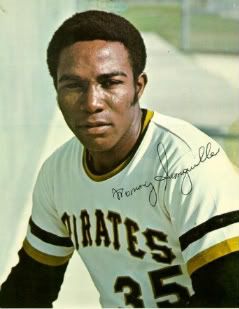
The Roadrunner Manny Sanguillen from Mop Up Duty


Manuel De Jesus Sanguillen Magan, better known as Manny Sanguillen, was born March 21, 1944 in Colon, Panama.

Along with Omar Moreno and Rennie Stennett, Sanguillen was one of the Panamanian stars that Pittsburgh scouts had discovered back in the Lumber Company days when the Pirates ruled the Latino roost. Panama is a mother lode of baseball talent and has produced stars like Mariano Rivera, Carlos Lee, Manny Corpas, and Rod Carew in addition to the Buc haul.

Sangy's first game for the Bucs was played on July 23, 1967. In his first full season of 1969, Sanguillen hit .303 for the Pirates. To put it mildly, he was a free swinger, and he used a long, heavy bat to swat pitches that were well off the dish.

If a ball got by him, it was a fairly safe bet that it was a wild pitch or a 55' curve ball. He was also a pretty decent baserunner for a catcher before his wheels went south on him later in his career.

He twice finished third in the NL batting race, in 1970 when he batted .325, and again in 1975 when he hit a career-high .328. Sanguillen was a great contact hitter, but rarely walked. Sangy also rarely struck out.

He never saw a pitch he didn't like and couldn't hit. Some thought he should show more plate discipline, but there wasn't a NL hurler of the era that had any idea of how to pitch to the swing-at-will Panamanian.

Sanguillen turned into a solid catcher, even if not exactly defensively stellar (some years passed balls plagued him.) But he was always among the league leaders in throwing out wanna be base stealers.

Sanguillen also liked to yap to the batters while he was behind the plate, sometimes while the pitch was in mid flight, just to distract them a bit from the job at hand.

Overshadowed by Johnny Bench, he edged out the Red's catcher on The Sporting News NL All-Star Team in 1971, the only time between 1967 and 1975 that Bench was not selected. Sangy was durable and dependable, catching more than 100 games in seven of his first eight full seasons with the Pirates.

The exception was 1973, when the Pirates tried to move Sanguillen to right field as the successor to its' legendary star Roberto Clemente. The experiment ended by July when Richie Zisk took over. That's all you need to know to realize how poorly Sangy was faring in the outfield. He gladly strapped on the tools of ignorance once again.

Sanguillen was a close friend of Clemente. He was the only Pirate that didn't attend Clemente's funeral. Sanguillen chose instead to dive into the waters off the Puerto Rican coast where Clemente's plane had crashed in a last ditch effort to recover his bud's body.

On November 6, 1976 Sanguillen was involved in one of the oddball trades in the MLB annals. He was sent to the Oakland A's in exchange for manager Chuck Tanner and $100,000. To this day, Sanguillen is the only player in major-league history to be traded for a manager.

After one season with the A's, Sanguillen was dealt back to the Pirates for Miguel Dilone and Elias Sosa.

He won two World Series with the Pittsburgh Pirates in 1971 & 1979. He batted .379, collecting 11 hits for the Pirates in the 1971 World Series and contributing a two-out, game-winning RBI single in Game 2 of the 1979 World Series, both against the star crossed Baltimore Orioles.

After playing for Pittsburgh virtually all of his career, Sanguillen last suited up for the Bradenton Explorers of the Senior Professional Baseball Association in 1989. In 13 big league seasons, 12 with the Bucs, he hit .296, scored 566 times and drove in 585 runs.

Ronny Paulino and Ryan Doumit have been receiving extra defensive instruction throughout camp, and God knows they need it. Sangy, a special spring instructor, is just the guy to teach them the ropes.

Trying to show his young charges how to field a throw to the plate like an infielder, he grabbed a mitt and mask (at the age of 63 and just coming off major knee surgery) and took a couple of pegs. They bounced off him - Sangy blamed the mitt, hehe - but his point was made.

"How about Manny?" Paulino asked WTAE TV. Doumit added that "He played back in the era when men were men. ...he would have gone out there without a mask unless we'd given it to him." Fortunately, the Buc staff curbed his enthusiasm and gently reminded Sanguillen that drill was for the catchers, not the coaches.

Now Sangy does less physical work, but he still gets to hang out at PNC Park. Walk out to center field and say "hi" to the smiling guy sitting on a lawn chair hawking Manny's BBQ. The pulled pork sandwiches are pretty dang good, and if you ask nicely, you'll even end up with an autograph. The Roadrunner is still a crowd pleaser. (To prove it, he ran away with our poll for Pittsburgh's best catcher, taking a whopping 72% of the vote.)

(Our contribution to spring training will be highlighting the careers of the old Bucs in camp who are trying to pass on the torch to today's squad. Up next - Steve Blass.)

Wednesday, March 5, 2008

the quail

bill virdon
Bill Virdon from Drury University


Bill Virdon was born in Hazel Park, Michigan in 1931 and grew up in West Plains, Missouri.

He was a top notch man with a glove and a solid batsman during his playing days as a center fielder for the St. Louis Cardinals and Pittsburgh Pirates. Virdon also had a long career in the majors as a manager with the Pirates, New York Yankees, Houston Astros, and Montreal Expos.

Virdon played basketball at Drury University, ala Dick Groat and Duke, in Springfield, Missouri before embarking on a major league baseball career. In 1950, at the age of 18, he signed with the New York Yankees but was traded in a multi player deal four years later to the St. Louis Cardinals for Enos Slaughter, now a member of the Baseball Hall of Fame.

After another year in the minors, Virdon joined the Cardinals in 1955 and was named National League Rookie of the Year, hitting .281 with career highs of 17 home runs and 68 RBI.

But when Virdon got off to a slow start in 1956, St. Louis GM Frank Lane, popularly known as "The Trader," sent him to the Pirates on May 17 for Bobby Del Greco and Dick Littlefield just 24 games into the season. It was his - and the Pirates - luck that the Card farm system had a kid named Curt Flood rising meteorically in it, and he would become their CF'er in 1958.

As an aside, that 1956 Card team was home to quite a few parts of the championship 1960 Pirate squad. Over the next few years Virdon would be joined by old teammates Hal Smith, Rocky Nelson, Dick "Ducky" Schofield, Vinegar Bend Mizell, and Harvey "The Kitten" Haddix. Joe Brown made made good use of St. Louis' roster when he remade the Bucs.

Virdon finished the year with a career-high .319 average and was a fixture in center for the Pirates through 1965. Because of his long, lanky appearance and grace in the outfield, he was dubbed "The Quail" by Pirate broadcaster Bob Prince.

In the 1960 World Series, Virdon was a key figure in three of the four Pirates' victories.

He made dazzling catches on balls hit by Yogi Berra in the opener and Bob Cerv in Game 4, and he bounced the grounder in Game 7 that smacked Yankee shortstop Tony Kubek in the throat and sparked Pittsburgh's legendary roller coaster victory. And all this time you thought it was Maz's home run that did it!

He won his only Gold Glove in 1962. #18 had a reputation as a swift and dependable center fielder , but some guy named Willie Mays kept taking home those Gold Gloves. Go figure.

A left-handed batter who threw righty, Virdon's MLB batting average was .267 with 91 home runs, 735 runs scored, and 502 RBIs during his 12 year, 1,583-game NL career. He has a Gold Glove and World Series trophy sitting on his mantel, too. Then he started his second career.

Virdon coached in Pittsburgh under Danny Murtaugh before eventually replacing him in 1972. He led the Pirates to the division championship that year but lost to Cincinnati in the NLCS when Dave Guisti gave up a homer and then Bob Moose uncorked a wild pitch in the final inning of Game 5, allowing the winning run to jog home.

He lost his Bucco gig late in 1973 after butting heads with Dock Ellis and Richie Hebner, a pair that a full house couldn't beat.

He landed on his feet quickly, though. Virdon was George Steinbrenner's second choice for Yankee manager in 1974 when Dick Williams was unable to take the job. Virdon was able.

He brought the club in second and won The Sporting News Manager of the Year honors. But that didn't cut any bait with Boss Steinbrenner. Virdon was canned for Billy Martin on August 1, 1975. Talk about temperamental opposites!

Two weeks later Houston hired him. In six full seasons with the Astros, Virdon only finished lower than third once. He took the team to the playoffs in 1980 and was again named TSN Manager of the Year. He came within an inning of the World Series once more, losing the NLCS to the Phillies in the tenth inning of Game 5. His playoff career was getting to be like the movie Groundhog Day.

Virdon finished his managing days with a two year run in Montreal in 1983-84.

His lifetime managerial record over 14 seasons was 995-921. Virdon won three division titles (his Astros lost in 1981 to LA), though he never quite made it to the World Series as a manager. He also served three different stints as a Pirate coach.

Virdon has the rare distinction of being replaced twice by the same manager that he replaced. In Montreal he played revolving doors with Jim Fanning and in Pittsburgh it was with his mentor, the "Smiling Irishman" Danny Murtaugh. On the sunny side of the street, he was one of the few men to be selected Manager of the Year in both the NL & AL.

Bill Virdon was honored by a Lifetime Achievement Award from his alma mater, Drury University. He was also inducted into the Springfield Sports Hall of Fame in its inaugural class of 1987.

Currently Virdon lives in Springfield, Missouri, and serves as a special outfield instructor for the Pirates during spring training.

He still looks like a professor with his wire rims and trim build, and in baseball lore he is one. Virdon believed in playing the game right and sticking to the fundamentals. If he can pass that lesson on to his young Bucco charges, half the battle will be won.


(Our contribution to spring training will be highlighting the careers of the old Bucs in camp who are trying to pass on the torch to today's squad. Up next - the Roadrunner.)

Monday, March 3, 2008

the rubber band man

teke
Teke Tekulve from Mop Up Duty


Kenton Charles "Teke" Tekulve was born March 5, 1947 in Cincinnati, Ohio. He pitched for Marietta College and the Pirates drafted him when he graduated in 1969.

The Rubber Band Man worked exclusively out of the bullpen from 1974 to 1989 for the Pittsburgh Pirates, Philadelphia Phillies and Cincinnati Reds.

He looked like a soft breeze could blow him off the mound, but in reality he was a workhorse and led the major leagues in appearances four times. Tekulve pitched in 90 or more games three times. He and Mike Marshall are the only pitchers in baseball history to appear in 90 games more than once.

He holds the National League record for career innings pitched in relief (1,436-2/3), and held the major league record for career relief appearances until Jesse Orosco broke his record in 1999. Teke's 1,050 career games ranked second in MLB history to Hoyt Wilhelm's 1,070 appearances. He's now seventh on the all-time list of wins in relief with 94.

Tekulve was one of the great sidewinders, and threw a sinker, slider and a slow curve that he used as a changeup, from every angle he could contort his lanky frame into. With those shades, windmill gyrations, and 6'4", 180 pound frame, he often looked like Ichabod Crane being pursued by the Headless Horseman. But could he ever whip a baseball.

He went 10-1 as a set-up man for Goose Gossage in 1977, and took over as the Pirates' closer after Gossage signed with the Yankees in November. Teke was the man for the job, as different as night and day from the Goose but every bit as effective. Tekulve set a club record for saves with 31 in 1978, compiling an 8-7 slate with a 2.33 ERA. He led the National League in appearances in with 91.

His best season arguably came in 1979 (some say it was 1978) when he pitched in 94 games, posting a 10-8 record with 31 saves, a 2.75 ERA, and a league-leading 94 appearances. The year was topped off by his 3 saves in the World Series, striking out 10 Orioles in 9-1/3 innings. The 3 saves were a Series record until John Wetteland closed out 4 games in 1996.

Teke led the National League with 85 appearances and 12 relief wins in 1982. In 1983, he saved 18 games with a dazzling 1.64 ERA. His Bucco era was drawing to a close, and he was traded by the Pirates to the Philadelphia Phillies for for Al Holland and Frankie Griffin in April, 1985.

In 1986 he broke Roy Face's NL record of 846 career games, pitching as a set-up man. Tekulve held the mark until John Franco passed him in 2004. Teke once again led the NL in appearances with 90 in 1987 while pitching for the Phillies at the age of 40. Tekulve also broke the MLB record for the most appearances as a pitcher without making a start when he topped Sparky Lyle's mark that same year.

Let go by the Phils after 1988, he signed with the Reds. Midway through the season, with the Reds near the bottom of the standings, he retired rather than hang on in the hope of topping Wilhelm's record for total appearances. He ended his career 20 games shy of the mark.

In 16 years in the bigs, Tekulve had a 94-90 record with 184 saves and a 2.85 ERA. He was an All-Star in 1980, won a World Series, and is second in Pittsburgh's all-time history in saves, appearances and relief innings pitched to ElRoy Face. Teke holds the Bucco record for most games finished in a year with 67 and is tied with Solomon Torres with most appearances in a season with 94.

In 1990 he worked for the Pirates community relations office and then was a Phillies broadcaster from 1992 to 1997. After a couple of years as a coach and director of baseball operations for the independent Frontier League Washington Wild Things, Tekulve took a job as the Buc's advance scout in 2006 - allegedly the first full-timer the team ever hired. He's also the director of the fantasy camp and a Pirate caravan regular.

In the spring, he puts down his computer and video cam and works as a special instructor for the Pirates. He's a bit pudgier than he was in his playing days, but don't let that fool you.

If he can get the pitchers in camp to want the ball as badly as he did and throw strikes when they get it like he did, the Bucs won't need his scouting reports. The Rubber Band Man will have done his job.

(Our contribution to spring training will be highlighting the careers of the old Bucs in camp who are trying to pass on the torch to today's squad. Up next - the Quail.)

Sunday, March 2, 2008

number nine

maz
Maz's 1960 Series Winner from Wikipedia


William Stanley Mazeroski was born September 5, 1936 in Wheeling, West Virginia. Before Maz entered school, his coal miner father Lew moved the family to rural Tiltonsville in Ohio, where they lived in a one room house without electricity. His dad, though an alcoholic, found the time to teach his son the basics of baseball.

He attended Warren High School and starred in both baseball and basketball. He started on the varsity baseball team as a freshman and took his basketball team to the state finals as a 5' 11-1/2" center. Warren HS has since consolidated to form Buckeye Local High School. Buckeye HS honored him in 2003 by naming their new baseball field after him and dedicating a Maz monument behind home plate.

As a 17-year-old in 1954, Mazeroski signed with Branch Rickey and the Pittsburgh Pirates straight out of high school. Originally penciled in at shortstop, he was quickly moved to second base and made his debut in the show on July 7, 1956. Maz would spend his entire career (1956-72) with Pittsburgh. He claimed two World Series titles and was elected to the MLB Hall of Fame.

Mazeroski's calling card was his leather and he earned his first of eight Gold Glove Awards in 1958. He helped turn 1,706 DP's in his career, and handled 11,865 plays with a fielding percentage of .983 (the league average was .976) - and on Forbes Field's notoriously rugged infield yet. The ball barely seemed to touch his beat up mitt before it was on its' way to first base.

Former Pirates centerfielder Bill Virdon told ESPN, "Nobody ever played second base like he did, and I've been in the game 50 years. The impressive thing about Maz was that he did everything perfectly. I backed him up for 10 years and never got a ball."

Maz had several fine offensive seasons, too. In 1958, he batted .275, hit a personal high of 19 home runs, drove in 68 RBIs and got some votes for the MVP Award, finishing 8th. In 1966 he knocked in 82 runs, a career best. His high water mark for batting was reached in 1957 when he hit .283.

And Maz one was one of the tougher batters to strike out, finishing in the NL top ten in that category 8 times. He credits Danny Murtaugh's patience (Bobby Bragan, his first manager, would pull him for a pinch hitter in a heartbeat) and hitting coach George Sisler's advice to stay deep in the box and wait on pitches for making him a competent major league hitter.

During his heyday between 1957-68, he drove in more runs than any other middle infielder in the business. In those 12 years, he accounted for 756 RBIs, an average of 63 per season. Not too bad for a guy hitting out of the eight hole. But he always was a money hitter in the clutch.

There weren't very many highs and lows with Maz. What you saw is what you got, day in and day out. And what Maz had was good enough to earn a spot in 10 All-Star games.

In the 1960 World Series, Maz hit the shot heard 'round the 'Burgh off New York Yankees pitcher Ralph Terry. "I don't know what that pitch to Mazeroski was. All I know is that it was the wrong one," Terry told Mike Aubrecht in the book "Yankee Killer."

It was the first time a World Series had ever been ended by a home run. It's still the only Game 7 walk-off home run in World Series history. To this day, it's the defining moment of Mazeroski's career and one of the shining moments of Pittsburgh sports.

Ted Szafranski, 13 at the time, caught the famous home run ball. He gave it to Maz in exchange for two cases of beer (presumably for his dad, but who knows?) Times have changed. We wonder what that horsehide would fetch on E-Bay today? The ball has since found a proper home in Cooperstown.

Today, part of the left field wall from Forbes Field remains standing, along with a marker where Maz's homer cleared the wall as a historic monument on Pitt's campus in Oakland. A little league diamond behind the wall is named Bill Mazeroski Field. Every October 13th, Bucco die hards still gather around those few red bricks and replay a tape of game 7. Maz even shows up sometimes.

That famous blast overshadows the fact that Mazeroski also hit a home run that decided the outcome of Game One. In the fourth inning, his shot off Jim Coates provided the deciding runs in a 6-4 victory. The Pirates hit four home runs in the entire Series; two were by Maz.

He hit the game winning homers in the first and last game of the Series. In fact, he was the honored with the Babe Ruth Award for the 1960 World Series - take that, Mickey Mantle! But he didn't get the Series MVP - that went to Bobby Richardson, his Yankee counterpart. We trust the championship ring was a suitable substitute.

Maz holds the MLB career record for double plays by a second baseman with 1,706, and set the single season standard in 1966 with 161. He led NL second basemen in double plays a record eight times; in chances accepted another record eight seasons; and in assists a record setting nine times, including five straight (1960-64) for another NL mark. His 163 games at second base in 1967 set the MLB record, and he tied the NL record of five seasons with more than 500 assists.

Pirates broadcaster Bob Prince nicknamed him "The Glove". That's one moniker from the colorful Gunner that everyone understood.

Mazeroski was elected into the Baseball Hall of Fame in 2001 after a 20 year wait. Reading his speech, he only got as far as thanking the Veterans Committee for choosing a player because of his glove rather than bat before becoming teary eyed. He had to stop and apologize to the fans.

He said "I want to thank all the friends and family that made this long trip up here to listen to me speak and hear this crap. Thank you very, very much. Thanks everybody. That's enough." He then sat down, choked up and emotionally drained.

The audience and his fellow Hall-of-Famers stood and roared out their appreciation for the quiet man, who's career was finally validated by the HOF selection. It took the Veteran's Committee just one vote to correct the error the Baseball Writers had made over the past 15 years in bypassing Maz.

In 2004, the Ohio Valley Athletic Conference honored Mazeroski by selecting him to the first class of honorees in the Ohio Valley Athletic Conference Hall of Fame. He was introduced by veteran sports writer Rick DeLuca, a 1970 graduate of Maz's alma mater, Warren HS. Maz was inducted with a group that included former Boston Celtics great John "Hondo" Havilcek.

Mazeroski received another standing ovation from the city's fans on July 10, 2006 when he threw out the first pitch of the Home Run Derby that preceded the MLB All-Star game at PNC Park. Those young lions can only dream of matching his feat.

He serves as special infield instructor for the Pirates in spring training. You can see Maz standing in between Jack Wilson and Freddy Sanchez on a Pirate City infield, dropping pearls of wisdom to today's middlemen. It must be rubbing off. The duo is turning DP's at an almost Maz/Gene Alley-like rate.

He lives in Panama City, Fla., with his wife Milene, whom he met through Danny Murtaugh and married in 1958 (Buc pitcher Bob Purkey was the best man.) Maz spends his time playing golf and fishing for striped bass. He does a local TV spot or two, and coached a bit for the Pirates and Mariners. His son Darren is a retired junior college baseball coach.

The golden years have been good to Maz. John Bird even penned a book about him, "Twin Killing: The Bill Mazeroski Story."

Bill Mazeroski may have been #9 on the roster, but he's still #1 to generations of Pirate fans.

(Our contribution to spring training will be highlighting the careers of the old Bucs in camp who are trying to pass on the torch to today's squad. Up next - the Rubber Band Man.)